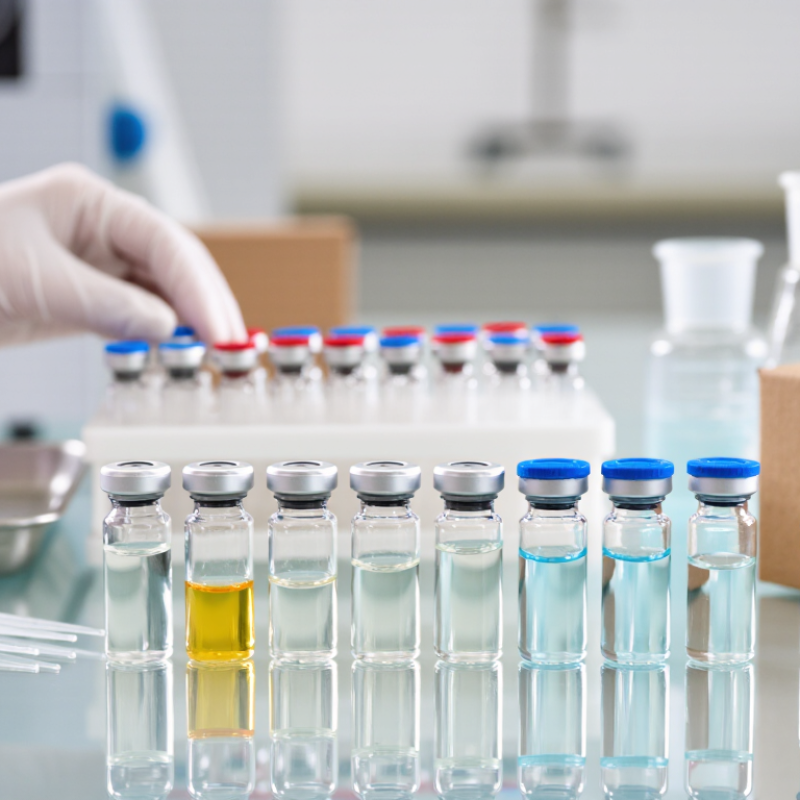
| Type I Borosilicate Glass |
Chromatography samples, injectable preparations, analytical standards, light-sensitive chemicals, long-term sample storage. |
Low chemical reactivity, low hydrolytic release, high transparency, good dimensional stability and strong resistance to thermal shock compared with ordinary glass. |
Suitable for many laboratory heating and cooling processes when temperature changes are controlled. Always verify the vial and closure specifications for freezing or thermal cycling. |
Clear or amber; screw-neck, crimp-neck, snap-cap, serum, headspace and autosampler formats. |
Excellent chemical compatibility, strong barrier against oxygen and moisture, low extractables when properly manufactured, and good optical inspection. |
Can break under impact; heavier and less transport-efficient than plastic; sudden temperature changes may cause breakage. |
Choose for high-purity, solvent-based, light-sensitive or regulatory-controlled samples where chemical inertness is important. |
| Clear Glass |
Routine sample collection, visual inspection, aqueous solutions, powders and general-purpose laboratory storage. |
Provides direct visual access to the sample and offers a strong moisture and gas barrier. Chemical suitability depends on the glass composition and the stored substance. |
Appropriate for standard laboratory temperatures and validated heating or cooling procedures. Avoid unverified thermal shock. |
Screw-cap, snap-cap, crimp-seal, flat-bottom and round-bottom designs. |
Good transparency, rigidity and barrier performance; compatible with many closure systems. |
Does not protect light-sensitive contents; fragile during handling and shipping. |
Use when visual inspection is required and the sample is not sensitive to ultraviolet or visible light. |
| Amber Glass |
Photosensitive pharmaceuticals, reagents, essential oils, standards and light-degradable compounds. |
Reduces transmission of much of the ultraviolet and blue-violet light spectrum while retaining the chemical resistance associated with suitable glass. |
Follow the same thermal handling precautions as other glass vials. Temperature protection does not replace validated storage conditions. |
Amber screw-neck, crimp-neck, dropper and autosampler vials. |
Helps limit photochemical degradation and supports long-term sample stability when paired with a suitable closure. |
Contents are less visible; amber color alone does not protect equally against all wavelengths or eliminate the need for light-controlled storage. |
Prefer for light-sensitive samples, and confirm the required light-transmission range with the testing or formulation method. |
| Polypropylene (PP) |
Aqueous buffers, biological samples, centrifugation workflows, cryogenic sample storage and routine reagent handling. |
Low density, good resistance to many aqueous chemicals, toughness and lower breakage risk than glass. Some solvents may cause swelling, stress cracking or permeation. |
Commonly used across refrigerated and frozen workflows; specific low-temperature performance depends on vial geometry, wall thickness and formulation. |
External-thread, internal-thread, snap-cap, skirted, cryogenic and micro-sample vials. |
Lightweight, impact-resistant, economical and suitable for many automated and high-throughput workflows. |
Higher gas and moisture permeability than glass; may show extractables, adsorption or deformation under unsuitable conditions. |
Choose for routine aqueous samples, transport-sensitive applications and frozen storage after checking solvent and temperature compatibility. |
| Polyethylene (PE or HDPE) |
Reagent storage, sample collection, dispensing and containers for many aqueous or mildly aggressive solutions. |
Good toughness and moisture resistance; chemical compatibility is generally favorable for aqueous materials but varies with solvent, concentration and exposure time. |
Suitable for common ambient and refrigerated use. Confirm dimensional stability before heating or extended freezing. |
Wide-mouth, screw-cap, dropper, squeeze and liner-equipped formats. |
Durable, lightweight and resistant to impact; useful for transport and routine handling. |
Less transparent than glass; can be more permeable to gases and organic vapors; may adsorb hydrophobic compounds. |
Use for robust routine storage and dispensing, especially where impact resistance is more important than optical clarity. |
| Fluoropolymer-Lined Closure System |
Highly aggressive solvents, volatile compounds, corrosive reagents and samples requiring low interaction with the closure. |
Fluoropolymer liners generally provide strong chemical resistance and low permeability relative to many common elastomers. The vial material and liner must be evaluated together. |
Temperature limits vary by liner, cap and vial combination. Validate sealing performance at the intended storage and transport temperature. |
Screw-cap vials with liner inserts, laminated liners and septum-lined closures. |
Can reduce chemical interaction, contamination and permeation through the closure when properly selected. |
Higher cost; sealing performance depends on torque, liner geometry, cap material and vial finish. |
Select when the closure is the likely source of contamination, evaporation or chemical incompatibility. |
| Silicone Septum with Fluoropolymer Facing |
Gas chromatography, headspace analysis, repeated needle piercing and volatile-sample handling. |
Silicone provides resealing elasticity, while a fluoropolymer facing can improve resistance to many chemicals and reduce sample contact with silicone. |
Choose a septum rated for the analytical temperature and number of punctures. Excessive heat can affect resealing and background levels. |
Crimp-top headspace vials, screw-cap autosampler vials and magnetic-cap systems. |
Supports needle access, resealing and reduced evaporation in validated analytical workflows. |
May shed particles, generate analytical background or lose sealing performance after repeated punctures or unsuitable storage. |
Match septum chemistry, thickness and hardness to the solvent, instrument method and required number of injections. |
| Low-Binding Plastic |
Low-concentration proteins, peptides, nucleic acids and other samples vulnerable to adsorption on container surfaces. |
Surface treatment or resin formulation is designed to reduce binding, but performance depends on sample composition, contact time and surface area. |
Use within the validated temperature range of the specific vial. Freezing and thawing may change sample behavior or sealing performance. |
Low-volume screw-cap, microcentrifuge, cryogenic and multiwell-compatible vial formats. |
Can improve recovery of dilute or surface-sensitive samples and reduce sample loss during storage. |
Not universally low-binding for every analyte; may have higher cost and requires method-specific validation. |
Choose based on recovery data for the actual analyte rather than relying only on a general low-binding claim. |
| Aluminum-Sealed or Metal-Component Vials |
Specialized sample preservation, tamper-evident packaging and applications requiring high mechanical protection of the closure. |
Metal components can provide rigidity and tamper evidence, but direct chemical contact, corrosion and compatibility depend on coatings, liners and the stored material. |
Validate the complete assembly for temperature cycling, especially where differential expansion may affect the seal. |
Crimp-seal vials, lined metal caps and tamper-evident closures. |
Strong closure retention, visible tamper evidence and useful mechanical protection. |
Metal may react with certain chemicals if unprotected; opening may require dedicated tools; recycling composition can be complex. |
Use when tamper evidence, closure retention or specialized sealing is required, after confirming liner compatibility. |
| Design Factor: Capacity |
Sample volume selection for analytical, storage and transport workflows. |
Common laboratory vial capacities range from micro-volume formats below 1 mL to larger formats of several tens of milliliters. |
Leave suitable headspace for expansion, mixing and volatile samples; do not overfill frozen containers unless specifically designed for it. |
Micro-vials, standard vials, scintillation-style vials and wide-mouth containers. |
Reduces waste, supports accurate dosing and can improve storage efficiency. |
Very small vials may be difficult to fill, label and handle; oversized vials increase headspace and material use. |
Select the smallest practical capacity that accommodates the working volume, headspace and testing method. |
| Design Factor: Closure and Seal |
Protection against evaporation, contamination, oxygen, moisture and leakage during shipment. |
Seal quality depends on thread or neck finish, liner or septum material, cap torque and manufacturing tolerances. |
Temperature changes can alter pressure, liner elasticity and dimensional fit; test the full closure system under actual conditions. |
Screw-cap, crimp-cap, snap-cap, septum, tamper-evident and child-resistant designs. |
Properly selected closures preserve sample integrity and support regulatory or chain-of-custody requirements. |
A chemically compatible vial can still fail if the closure leaks, sheds particles or permits excessive permeation. |
Evaluate vial, cap, liner and sealing process as one system rather than selecting the container alone. |
| Design Factor: Bottom and Shape |
Storage stability, automated handling, centrifugation, mixing and shipping efficiency. |
Flat bottoms improve upright stability; conical or round bottoms can aid recovery of small liquid volumes and reduce dead volume. |
Shape affects stress distribution during freezing, centrifugation and thermal cycling; confirm equipment compatibility. |
Flat-bottom, round-bottom, conical-bottom and skirted designs. |
Improves rack compatibility, liquid recovery and process consistency. |
Some shapes require dedicated racks or adapters and may be less stable without support. |
Match the bottom geometry to centrifuge rotors, racks, robotic grippers and the required residual volume. |
| Design Factor: Light Protection |
Protection of compounds that degrade under ultraviolet or visible light. |
Amber glass and opaque or light-blocking plastics reduce light exposure; the actual protection depends on wall thickness and wavelength. |
Light protection does not control temperature, oxygen or moisture; use the complete validated storage condition. |
Amber vials, opaque vials, light-blocking sleeves and secondary packaging. |
Can extend usable sample life and reduce photodegradation during storage and transport. |
Opaque containers limit visual inspection; some plastics may still transmit selected wavelengths. |
Use measured transmission data when the analyte has a known wavelength-specific sensitivity. |
| Design Factor: Sterility and Cleanliness |
Cell culture, microbiology, pharmaceutical development and trace-level analytical work. |
Sterile, depyrogenated or pre-cleaned vials are processed to defined cleanliness requirements; the specification must identify the test method and acceptance criteria. |
Confirm whether sterilization has altered the vial, closure or surface treatment, especially for polymeric components. |
Individually wrapped, bulk-packed, sterile, depyrogenated and certified low-particle formats. |
Reduces contamination risk and supports controlled laboratory procedures. |
Higher cost and packaging waste; “clean” and “sterile” are not interchangeable claims. |
Request documented cleanliness, sterility or endotoxin specifications appropriate to the intended application. |