How to Choose a China Flat Washer Supplier in 2026?
Choosing a China Flat Washer supplier in 2026 means looking beyond a polished catalogue. Washers may be small, but inconsistent thickness, burrs, or coating can disrupt assembly and accelerate corrosion. The World Steel Association’s World Steel in Figures 2024 reports that China produced 1,005.1 million tonnes of crude steel in 2023. That figure gives raw-material context; it is not a measure of washer output or supplier quality.
For practical evaluation, compare drawings, material specifications, dimensional tolerances, coating requirements, and inspection records. Ask for sample measurements and traceability from the production lot to its material certificate. A factory’s ISO 9001 certification can support confidence in its quality system, but it does not prove that every washer meets your drawing. Small details matter. A clean edge matters. So does repeatability. W. Edwards Deming, a quality-management authority, wrote, “Quality comes not from inspection, but from improvement of the production process.” His work was not specific to washers, but the principle applies to supplier assessment.
I could not verify a public quotation from a named China flat-washer specialist, so attributing one would risk misleading readers. That limitation deserves attention. A useful supplier review should therefore rely on checkable evidence: current test reports, clear change-control procedures, consistent sample results, and direct answers about production capacity. Price still matters, of course. Yet a low quote can become expensive when a shipment arrives with mixed dimensions or incomplete records. The right China Flat Washer partner is not simply the cheapest factory; it is the supplier that can explain, document, and repeat its process.
Define Your Flat Washer Requirements and Application
Define the washer’s job before comparing suppliers. Is it spreading clamp load, protecting a painted surface, or bridging an oversized hole? Record the bolt diameter, required inner and outer diameters, thickness, material, finish, and applicable standard. ISO 7089 may suit general-purpose plain washers, but confirm its dimensions and product class match your drawing. Small details matter.
Application conditions narrow the material choice. A washer beneath a coated outdoor bracket faces different corrosion risks from one inside dry machinery. Check the bolt grade, joint load, vibration, temperature, and mating-surface hardness; a washer that is too soft may deform, while an unsuitable finish can damage the assembly.
The World Steel Association’s World Steel in Figures 2024 reports 1,892.2 million tonnes of global crude steel production in 2023. That figure describes a large raw-material base, not the consistency of any washer lot.
Ask suppliers for material certificates, dimensional inspection records, and traceability details.
Share a drawing and expected annual volume, then request samples from the intended production process. Measure thickness and outside diameter, and test fit them against actual mating parts. Drawings can miss assembly variation; I still treat them as a starting point. A clear specification makes supplier quotations easier to compare and reduces avoidable surprises.
Compare Materials, Dimensions, and Applicable Standards
A reliable China flat washer supplier should be able to explain how material, dimensions, and standards fit your application. For general fastening, carbon steel can be economical, but its protective coating matters in humid storage or outdoor use. Stainless steel 304 suits many mildly corrosive environments; 316 may be preferable near saltwater. Ask for material and coating details, not just a grade on a quotation. Small differences matter.
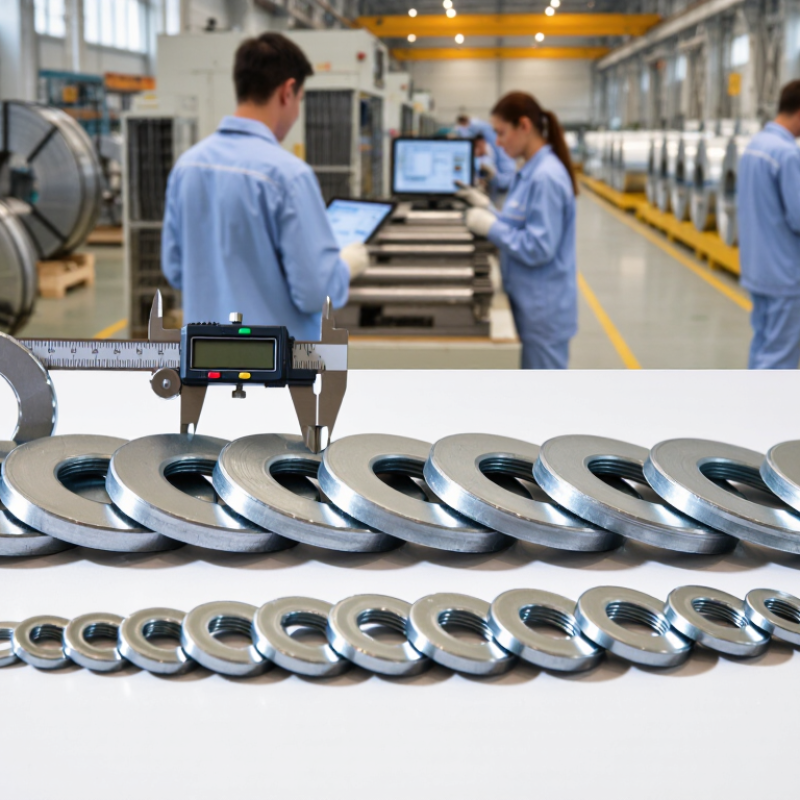
Check the inside diameter, outside diameter, and thickness against your bolt size and assembly drawing. A washer that looks close can still sit unevenly or fail to spread the load as intended. Request samples and measure them with calipers; compare several pieces, not only one. Confirm tolerances in writing, especially for high-volume orders. This step takes time, but skipping it can cost more.
Applicable standards help make specifications consistent. Ask whether the washer follows ISO 7089 or another standard named in your drawing, and confirm the exact edition and washer type. DIN references may appear in older documents, so do not assume two labels mean identical dimensions. Request inspection records or material certificates when the application calls for them. Paperwork is useful, though it cannot replace checking the actual parts. A clear drawing, agreed standard, and documented inspection plan give both sides fewer surprises.
Assess Supplier Manufacturing Capabilities and Quality Controls
A capable China flat washer supplier should explain how its process keeps dimensions consistent, not just offer a competitive price. Ask about press capacity, tooling maintenance, and the materials it can process. For washers, check that the supplier measures inner diameter, outer diameter, thickness, and flatness against your drawing. Small details matter. Burrs around a punched hole can affect fit and handling.
Quality controls should cover incoming material, production checks, and final inspection. Ask how often operators sample parts and what measuring tools they use. A clear inspection record should identify the batch, measured dimensions, and acceptance criteria. If the washer has a coating, ask how coating thickness and appearance are checked. Photos can help, but they cannot replace measurement data. A polished audit sheet alone proves little.
Before placing a large order, request samples made with the intended material and process. Compare them with your drawing, then ask how the supplier handles nonconforming parts and corrective actions. Traceability matters if a defect appears later. Even a thorough review can miss problems that emerge during sustained production, so keep checking early shipments. Supplier answers may sound precise; verify them with records and physical samples.
Verify Certifications, Traceability, and Export Readiness
How to Choose a China Flat Washer Supplier in 2026?
A reliable supplier should show more than a certificate on a website. Request current quality-system certificates, confirm the issuing body, and check that the certified site matches the factory making your washers. Then ask for sample inspection records, material specifications, and a batch number you can trace from production to packing. A certificate is only a starting point. It does not prove every lot meets your drawing.
Traceability should be practical. Ask the supplier to link each carton’s label to its production batch, material records, and inspection results. For export readiness, review a sample commercial invoice, packing list, carton markings, and proposed packaging. Clear records reduce avoidable delays, though they cannot guarantee smooth customs clearance. The World Bank’s 2023 Logistics Performance Index assessed 139 economies across six dimensions, including customs, tracking and tracing, and timeliness. That framework is a useful reminder: a quoted lead time alone tells you little about shipment control.
Tips: Request one recent, anonymized shipment file and trace a carton back to its inspection record. Check whether washer dimensions and tolerances match your specification, not just a generic catalogue. Small details matter. I would also ask how the supplier handles a failed inspection; a vague answer deserves a follow-up. No supplier’s paperwork is perfect, and that is exactly why dated, consistent records are more persuasive than polished claims.
Evaluate Quotes, Lead Times, and Long-Term Supplier Fit
How to Choose a China Flat Washer Supplier in 2026?
Evaluate Quotes, Lead Times, and Long-Term Supplier Fit
A competitive quote is useful only when its details are clear. Check washer material, thickness, diameter tolerance, finish, packaging, and inspection scope. Ask whether tooling, samples, and freight are included. A low unit price can hide extra charges or different specifications. Compare like with like. Request a sample and measure it with suitable gauges before approving production.
Lead time deserves the same scrutiny as price. Ask for separate estimates for sampling, production, and shipment, then check what could delay each stage. A supplier should explain its capacity and how it handles an urgent order or a rejected batch. Be cautious with promises that sound exact but lack a production schedule. A common planning mistake is treating one successful sample as proof of consistent output. It is not.
Tips: Share a marked-up drawing and your expected annual volume. Ask how inspection results are recorded and how changes are approved. Keep the first order manageable, but do not judge long-term fit by one delivery alone. Responsiveness matters, though a quick reply cannot replace clear records. A little uncertainty remains; build room for it.
How to Choose a China Flat Washer Supplier in 2026?
Use these ISO 7089 reference dimensions to check product consistency across supplier quotes. Confirm material, finish, tolerances, minimum order quantity, total landed cost, and quoted lead time directly with each supplier; these terms vary and have no universal benchmark.
